The Pleasure of One Good Thing
A chair that is more than a seat, and what makes it worth keeping
My Bertoia Diamond chair is mostly air. That is the first thing anyone notices about it; the irony is how solidly it cradles you. I bought it at an auction house in Philadelphia more than twenty years ago. It was an original from the 1970s, in pristine condition, with a chrome finish. I ordered a replacement cushion from Knoll in red bouclé, which was not cheap. I wanted it done properly.
The red and the texture of the bouclé added warmth to the metal grid. For something you could see through, the chair had a remarkable presence: it gave the room breathing space while drawing the eye toward itself. As the sun moved, the wire cast shadows that stretched and shifted across the floor. I loved watching them, and I read many good books in that chair.
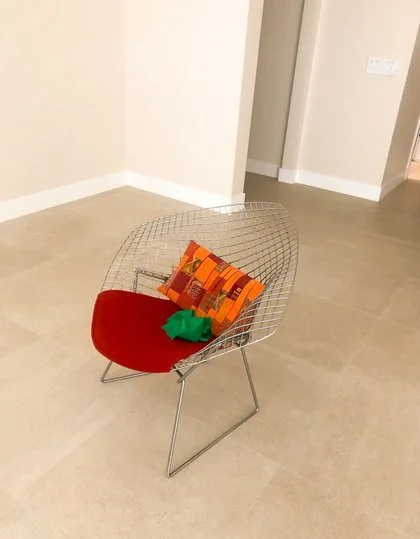
Always first one to arrive.
A Chair That Makes a Home
In my Philadelphia loft office, it sat like a sculpture beside a round side table and a black Tizio lamp. Beneath it lay a vintage Turkish kilim, which I had carried back in my backpack in my twenties, with geometric motifs in red, orange and pink. It looked remarkably modern alongside the open metal frame.
When we moved to an ultramodern San Francisco house, it sat in my home office, where it held its own among contemporary Cassina pieces, a Victorian quarter-sawn oak bookcase and Danish built-ins. Good design is enduring, and pieces from different eras find each other excellent company.
A decade later, as my marriage was ending, I moved into a Victorian one-bedroom in the Mission District. The chair came with me, and it gave me solace in that new space. The flat was tiny but warm, surrounded by some of the city’s most interesting cafés, restaurants and shops. White linen curtains billowed at tall, wooden-framed windows as fresh San Francisco air and sunlight filled the room. Roxy Music played in the background. I sat in the Bertoia rereading The Corrections, with coffee freshly brewed in my 1970s Chemex. For a while, I forgot everything that was wrong in my world, and that moment seemed perfect.
In my condo in St. George, which I bought as a vacation home, the chair arrived first, traveling with me in my car. It was light enough for me to carry and place wherever I wanted. It gave the empty room a presence, and me a comfortable place to sit while I waited for the rest of the furniture to arrive. When I decided to move to St. George permanently, it was again the first piece placed in my new, empty home, well before moving day.
Some might say a chair is just a chair. This one accompanied me through homes and circumstances I could never have anticipated when I bought it. Wherever it landed, it gave me the same satisfactions: lasting design, ergonomic seating and all the memories of every space it lived in with me.
Why One Good Thing
Spending thousands of dollars on a single chair is hard to justify. For many people it is out of reach, and even for those who can afford it, the same money might buy a sofa and a dining table. The pleasure of continuing to notice one object is harder to measure.
A cheaper copy makes the question more pointed. If it looks much the same and provides somewhere to sit, why not buy that instead?
Part of the answer is in how the chair is made. Bertoia came to furniture through sculpture, and the Diamond shows it: a lattice of steel rods, welded where they cross, that reads almost like a drawing in space. Walk around it and it changes, nearly solid from one angle, nearly vanishing from another.
A copy can look convincing in a photograph, where a chair is relieved of its obligation to support a body. Bertoia developed his wire chairs through repeated experiments with form and sitting, positioning the wire and adjusting its shape. Knoll’s engineering helped turn those experiments into a chair that could be manufactured reliably without losing its sculptural lightness. The apparent ease of the finished chair conceals the work of both.
Even a faithful copy would leave something missing for me. I value the original as an authentic expression of an artist’s work. The imagination and effort behind it are part of what I admire, and living with that achievement gives me a private pleasure. Nobody else needs to recognize it for that to matter.
That regard also shapes how I care for the chair. Buying the replacement cushion Knoll makes for it was worth the expense; I wanted to keep enjoying it for years to come. Through every move, I found a place for it. Its value to me never depended on whether it suited the next room.
A Room Built Piece by Piece
Given a limited budget, I would rather wait for one original I love and mix it with well-chosen IKEA pieces and secondhand furniture with good bones. A refurbished antique table or vintage cabinet brings workmanship and character of its own. I enjoy the ingenuity of an affordable design as much as the achievement of a piece I chose to spend more on. Price alone cannot account for either attraction.
A coordinated living room or dining set from a mid-priced showroom rarely interests me. Everything agrees a little too readily, and the same finish, curves and details recur from piece to piece, leaving little for the eye to discover. For someone else, that coordination may be restful, but for me it is a source of discomfort. I prefer to assemble a room gradually, allowing for an unexpected find or a combination I would not have thought to plan. For me, a room comes alive when an old object sits beside a new one: warm wood next to steel, a curve beside a straight line, each piece with its own story.
An inexpensive object with soul, whimsy or honest utility can hold my attention; an expensive one that is pretentious or without soul can leave me cold. What matters is having something worth returning to, with the eye as well as the body. The Bertoia is that to me, an original design I have loved living with for more than twenty years.
Full Circle
Soon after I moved to St. George permanently, I met Celia Bertoia, Harry’s daughter, by chance, and visited her gallery, the Harry Bertoia Foundation. I was delighted. I had always thought of Harry as a furniture designer, and I had no idea how accomplished a sculptor and artist he was. It all made sense to me, including why I had been so drawn to the chair. I fell in love with his abstract prints and Sonambient sculptures. One evening, I had her over for dinner, and she authenticated my chair. After all those years and all those homes, it felt almost fated.
I never bought the chair as an investment or a credential. I bought it because I liked the look and it was built right.
The Bertoia is here with me now. In the late afternoon, the wire still throws its shadows across the floor, and I still watch them move.